
Non-Surgical Knee Pain Treatment with Cryoablation for Knee Pain
– A Safer Alternative to Surgery
Are you tired of living with knee pain but hesitant to go under the knife? You’re not alone. Many people with knee osteoarthritis or chronic joint discomfort are now turning to safer, non-invasive options.
One of the most effective breakthroughs in non-surgical knee pain treatment is cryoablation—a minimally invasive procedure that “freezes” away pain signals with precision. If you’re seeking long-term relief without surgery, this technique might be just what you need.
In this blog, we will learn how cryoablation works, who it’s suitable for, and why it’s becoming a game-changer in knee pain management.
What is cryoablation for knee pain?
Are you tired of living with knee pain but hesitant to go under the knife? You’re not alone. Many people with knee osteoarthritis or chronic joint discomfort are now turning to safer, non-invasive options.
One of the most effective breakthroughs in non-surgical knee pain treatment is cryoablation—a minimally invasive procedure that “freezes” away pain signals with precision. If you’re seeking long-term relief without surgery, this technique might be just what you need.
In this blog, we will learn how cryoablation works, who it’s suitable for, and why it’s becoming a game-changer in knee pain management.
Why choose cryoablation over surgery?
Cryoablation is an innovative non-surgical knee pain treatment that offers several advantages over traditional surgery:
- It is a minimally invasive procedure and uses a needle-based technique—eliminating the need for cuts or stitches, and typically avoiding general anesthesia.
- Most individuals resume light activities within a day or two, with significantly less recovery time than knee replacement surgery.
- No hospital stay or extensive rehabilitation program is required. Pain relief is often felt within days.
- This is a safer alternative for elderly patients or individuals with underlying health conditions who may not be eligible for surgical intervention.
Cryoblation is ideal for patients with:
- Suffer from knee osteoarthritis or persistent pain after knee surgery
- Are not candidates for knee replacement surgery due to age or medical reasons
- Wish to avoid surgery or delay it
- Have not achieved relief with medications or steroid injections
How does cryoablation work for non-surgical knee pain treatment?
Cryoablation offers an effective non-surgical alternative for knee pain relief by targeting the genicular nerves— key sensory nerves around the knee joint that carry pain signals to the brain.
Here’s how it works:
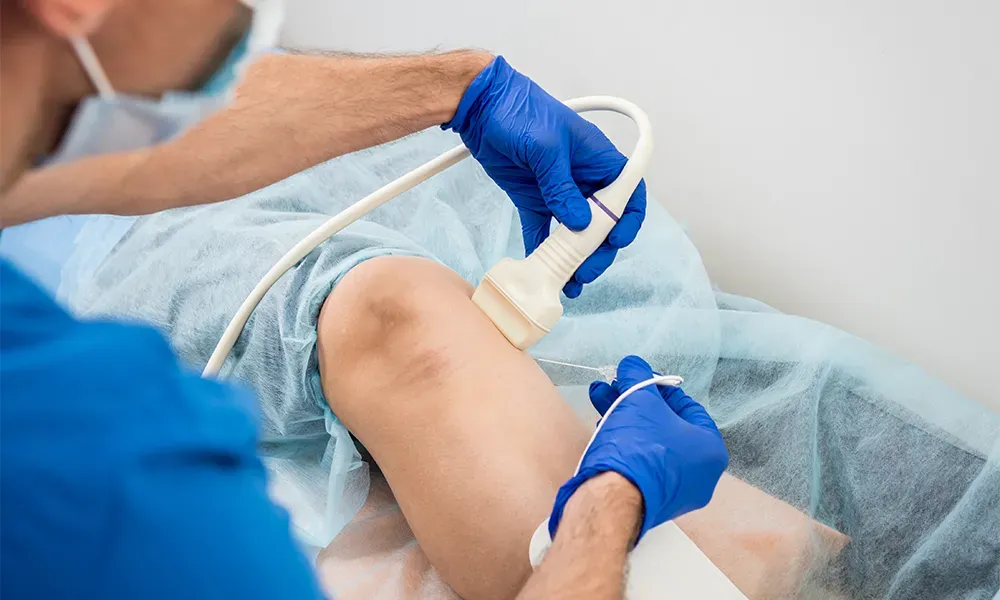
- During the procedure, a specialized cryoprobe is inserted near the nerves surrounding the knee under imaging guidance (such as ultrasound or fluoroscopy).
- This probe delivers extremely cold temperatures—typically using argon or nitrous oxide, which temporarily “freezes” the nerves and interrupts pain signals before they reach the brain.
- The nerve remains structurally intact and can regenerate over time, which means the procedure does not cause permanent damage.
The result is a significant reduction in knee pain—often immediate and lasting for several months.
What to expect after cryoablation for knee pain?
Recovery after cryoablation for knee pain is typically quick, simple, and far less intensive than surgical options.
Here’s what you can expect:
- You may feel mild soreness, numbness, or bruising at the injection site. This is temporary and usually resolves in a few days.
- Some patients experience immediate relief, while others feel the full effects within 3–7 days.
- Pain relief from cryoablation can last 3 to 6 months or longer. Once the nerve regenerates, the procedure can be safely repeated if needed.
How effective is cryoablation for knee replacement?
Clinical research strongly supports the effectiveness of cryoablation for managing chronic knee pain.
- In a 2024 study, patients reported a 40–60% reduction in knee pain within three months of treatment.
- Many patients also experienced improved mobility, reduced stiffness, and enhanced overall quality of life.
- Cryoablation has been shown to be as effective as radiofrequency ablation (RFA), but with less post-procedure discomfort.

FAQs
No, cryoablation offers long-lasting relief (typically 6–9 months) but is not permanent. The treated nerves regenerate over time. However, it can be safely repeated if needed.
Yes, many patients use cryoablation for knee replacement alternatives to delay or avoid surgery, especially when conservative treatments like medications and injections have failed.
Cryoablation is generally safe and well-tolerated. Temporary soreness, swelling, or numbness around the treatment area can occur, but serious complications are rare.
Take the first step toward pain-free movement
Consult Dr Mohamed Elfekky for non-surgical knee pain treatment in Dubai
If you’re seeking effective, non-surgical relief from chronic knee pain, Dr. Mohamed Elfekky offers cutting-edge solutions like cryoablation that prioritize your comfort, safety, and mobility. With over 25 years of orthopedic experience, Dr. Elfekky combines proven expertise with the latest advancements in pain management to deliver truly personalized care.
If you’re exploring non-surgical knee pain treatment, you’re in expert hands with Dr. Elfekky.
Recent Blog
Dr Mohamed Elfekky, Orthopedic Surgeon in Dubai, is a trusted expert in knee and joint care with over 25 years of experience in advanced, minimally invasive, and robotic-assisted surgeries. Read more
Social link
About Doctors
Dr Mohamed Elfekky, Orthopedic Surgeon in Dubai, is a trusted expert in knee and joint care with over 25 years of experience in advanced, minimally invasive, and robotic-assisted surgeries. Read more